Lead & CRM workflows
Capture enquiries, classify intent, update contact records and send qualified opportunities to the right person.
Connect the steps between an incoming request and a finished task. We build AI-assisted workflows, RPA and integrations around the way your team actually works.
Map your workflow ↗Explore AI Agents & Agentic Workflows →Form, email or business system
Extract, validate and route
Update a record or assign a task
A useful automation removes a specific bottleneck. We review the volume, exceptions and cost of the current process before recommending what to build.
Capture enquiries, classify intent, update contact records and send qualified opportunities to the right person.
Extract fields from invoices, forms and emails. Validate them against business rules and flag incomplete records for review.
Help teams find approved information, prepare responses and route requests that need specialist attention.
Handle repeatable desktop tasks and connect APIs, databases and notifications when information needs to move between tools.
Calculations, required fields and predictable routing belong in explicit business logic. Keep repeatable decisions consistent.
Language, document understanding and classification can benefit from AI. Validate outputs against the job they need to do.
Agree which exceptions, sensitive actions and low-confidence results require approval before the workflow proceeds.
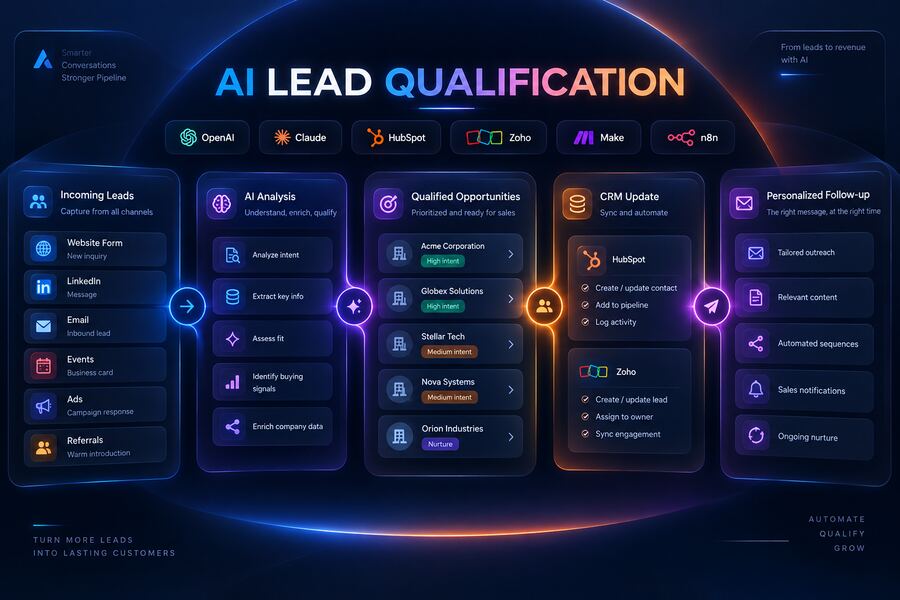
Explore our Intelligent Lead Qualification concept: capture an enquiry, assess buying intent, update the CRM and route the next action.
This is a solution blueprint, ready to be scoped around a client’s sales process. It is not a completed client deployment.
Explore the blueprint ↗Identify inputs, owners, exceptions and the result worth measuring.
Choose integrations, permissions, approval points and fallback paths.
Check realistic scenarios, including missing data and failed connections.
Document how to run, monitor and maintain the workflow.
No. Stable, rule-based steps usually work best with standard automation. AI is useful when a step needs language understanding, extraction or classification.
We first review the platform’s APIs, permissions and data quality. Where an API is unavailable, we assess alternatives such as RPA and explain the maintenance trade-offs.
The approach can include n8n, Make, UiPath and business-system APIs. Platform selection depends on your environment, licensing, process and support requirements.
We define validation rules, approval thresholds, retry behaviour and exception routes. The controls are matched to the consequences of each action.

Practical AI. Measurable business outcomes.
Automation, software and digital growth shaped around the way your business works.
Necessary technologies keep the site working. Choose whether to allow optional analytics and marketing. Cookie Policy